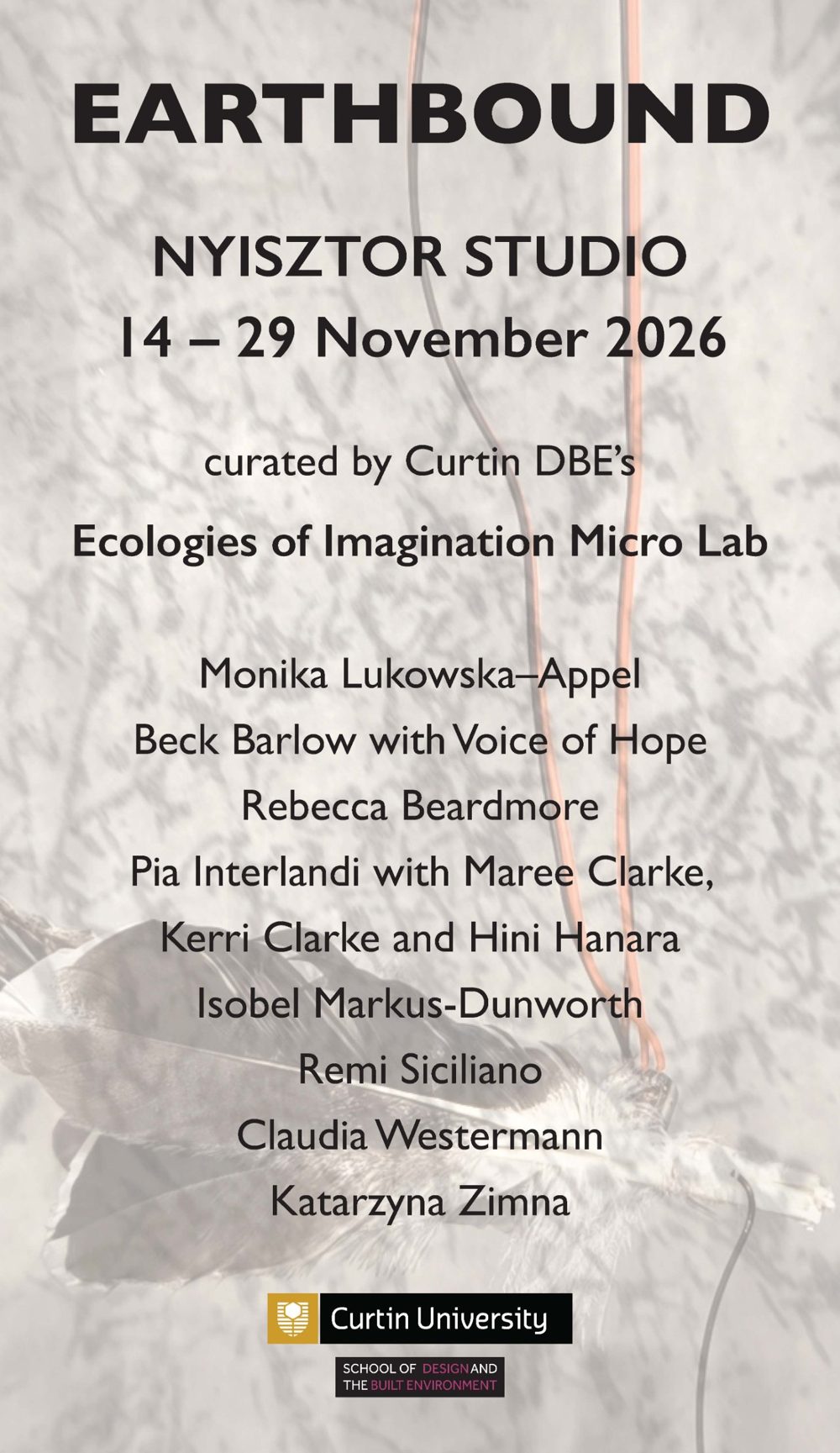
Earthbound
- 14 – 29 November 2026
- Nyisztor Studio, Unit 1/17 Essex Street, Fremantle WA 6160 Map
- Opening night Saturday 14 November, 5–7pm
- Curated by Curtin DBE’s Ecologies of Imagination Micro Lab
Exploring new ways of connecting with the world around us.
Ancient rulers held the Earth’s globe as a symbol of dominion; modern technological enterprises appropriated it to communicate reach and universality. The globe imagery has become ubiquitous and typically suggests the perspective of an external observer with an objective overview, acting upon Earth rather than living with Earth. Earthbound proposes a starting point that is critical of such imagery. To be earthbound is to resist externalisation; to insist that observers are always already part of the systems they observe. Being earthbound, we are not granted an objective overview.
Drawing on the ecologist Gregory Bateson’s notion of grace, a principle through which seemingly opposed perspectives are held together rather than resolved into one, Earthbound explores how creative practice might cultivate new ecological possibilities through ‘graceful’ attentiveness to the forces, materials, and agencies that exceed categorisation and control.
Earthbound presents transdisciplinary works by creative practitioners from the Ecologies of Imagination Micro Lab at Curtin University, the Sydney College of the Arts, The University of Sydney, and Lodz University of Technology that investigate transformation, decomposition, speculation, and emergence. The projects across design, textiles, installation, photography and print explore how creative practice might cultivate attunement to the earth and responsiveness to the dynamic, unfinished, and shared worlds we inhabit. As we challenge the view of Earth as an object to be observed, measured, and controlled, and instead embrace uncertainty, collaboration, and care, mastery is reconceptualised as the capacity to work-with, alongside, in the flow.
Artists
- Monika Lukowska-Appel
- Beck Barlow with Voice of Hope
- Rebecca Beardmore
- Pia Interlandi with Maree Clarke, Kerri Clarke and Hini Hanara
- Isobel Markus-Dunworth
- Remi Siciliano
- Claudia Westermann
- Katarzyna Zimna
The Lab
The Ecologies of Imagination Micro Lab at Curtin University’s School of Design and the Built Environment brings together researchers whose practices sit at the intersection of fashion, art, architecture, graphic design, and sustainability. A shared orientation holds these practices together. Investigating how creative practice can respond constructively to ecological crises and rapid technological transformation through a more-than-human speculative design approach, the Micro Lab’s members engage with processes of living in ways that resist simplified models. Their expertise lies in communicating ecological complexity to diverse audiences, using creative practice to drive action towards more sustainable futures.
Members of the Micro Lab bring extensive experience in working with educational and cultural institutions addressing general publics, including internationally renowned museums, galleries, and festivals, such as MoMA in New York, the Science Museum in London, the National Gallery of Victoria, the Museum of Modern Art in Frankfurt (MMK) and the Center for Art and Media (ZKM) in Karlsruhe; the Paris, New York and New Zealand Fashion Weeks; the Perth, Suzhou and Singapore Design Weeks; and diverse heritage-themed art and design festivals across three provinces in China.
The Lab draws on feminist and decolonial design frameworks and care ethics as the fundamental structure of learning, holding that agents – human and non-human alike, though never in the same way or to the same degree – interpret, interrupt, and transform the scripts that shape their worlds rather than merely executing them. This capacity for interruption is the generative core of relational practice; the resulting ecological imagination is as much a design competency as a political one.
Funded by Curtin University’s School of Design and the Built Environment. Led by Claudia Westermann and Monika Lukowska-Appel, with Lab members Pia Interlandi, Jo Li Tay, Andreas Pfeifle, and Beck Barlow.