Shelled and Feathered | a cartography of more-than-human living brings together three interconnected creative practices within the Ecologies of Imagination Micro Lab to explore what it might mean to make a map that lives beyond the reach of command. The work takes as its departure point two enduring symbols: the feather and the shell – each an archive of more-than-human life, each a fragment of a world that precedes and exceeds the human. Both are held within Pia Interlandi’s Textile Decomposition Database, an ongoing archive that records the material lives and origins of found organic matter as data and creative resource.
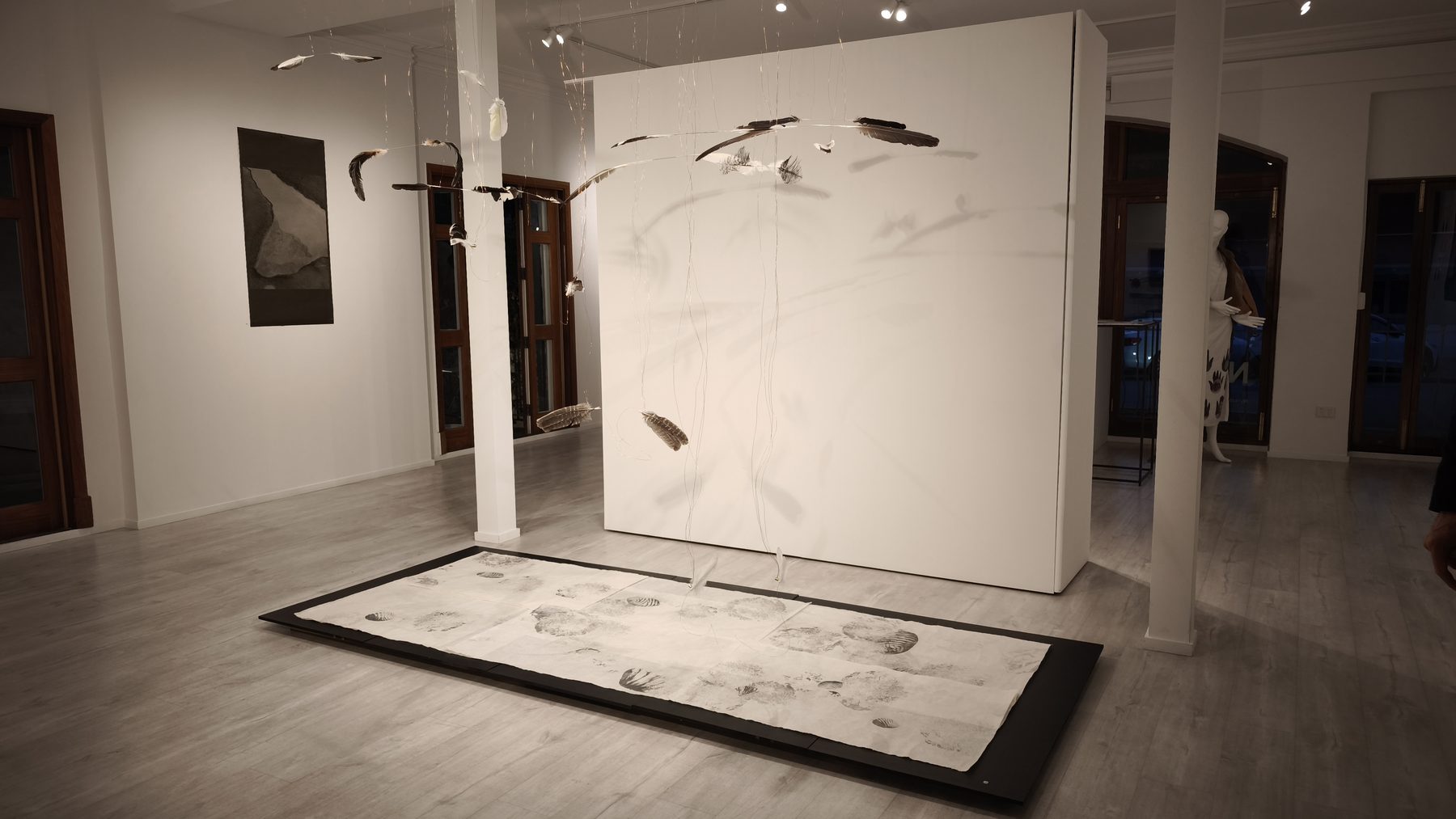
Monika Lukowska-Appel’s expansive print-works on delicate Japanese paper, slightly lifted from the floor, evoke a map and yet they resist the map as an instrument of imperial cartography and territorial claim. The prints derive from 3D forms generated by AI from fragments collected along Western Australia’s coastline: shells, corals, stones, and organic debris. Processed through Polycam and translated into large-scale printmaking, the resulting ‘map’ blurs the boundary between documentation and speculation, between the real and the imagined. Unlike the maps that once divided continents and claimed sovereignty over living worlds, this map records the quiet processes of coastal erosion, ecological transformation, and more-than-human agency.
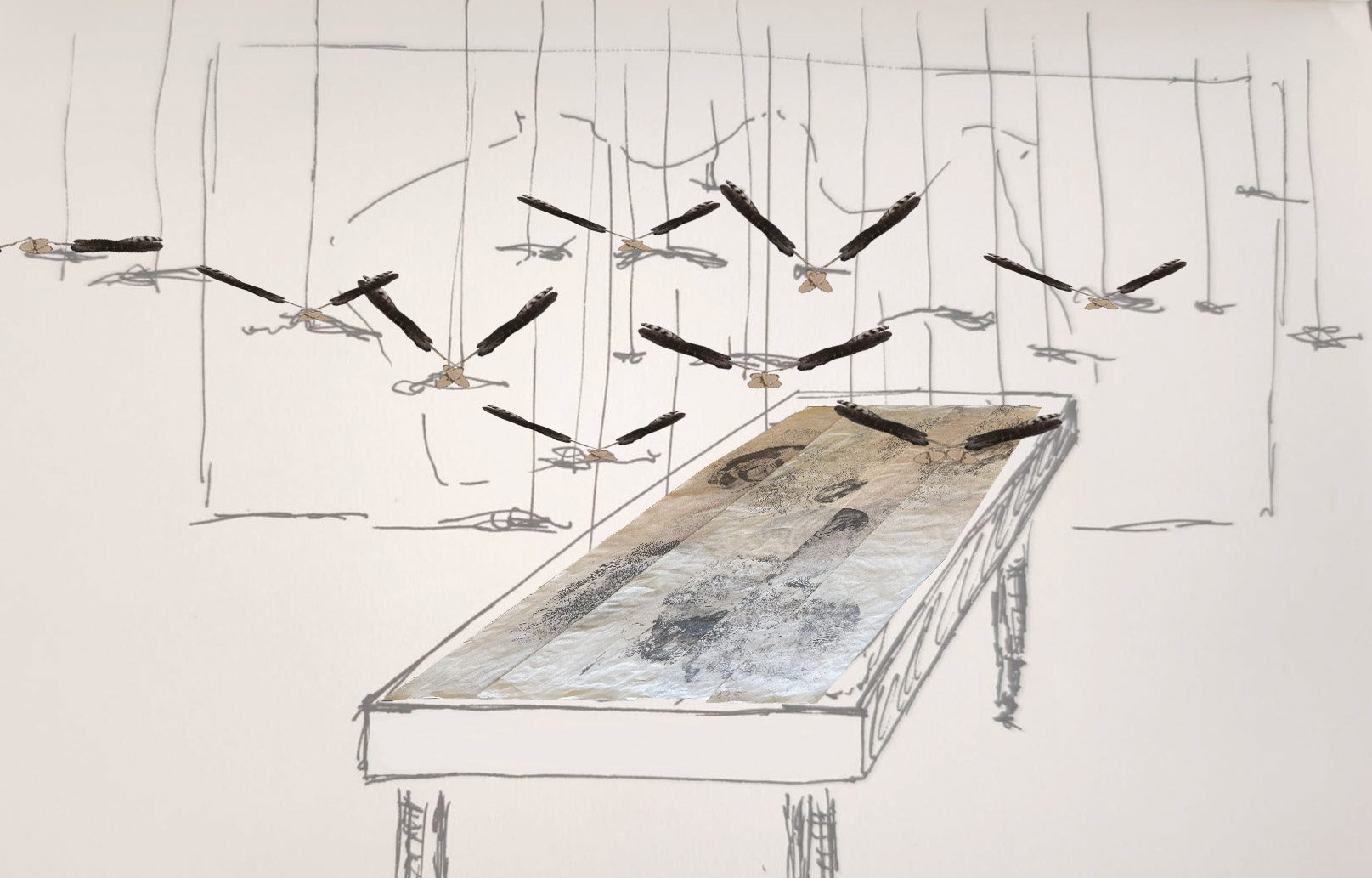
Pairs of feathers that Pia Interlandi collected across Australia hang freely from the ceiling above the table. Between them, also hanging from the ceiling, feathered ornithopters, drawing on Claudia Westermann’s prior work animating wild turkey feathers, are activated by small motors responding to visitors’ movement; their wings move across and beyond the edges of the territory marked by Lukowska-Appel’s prints. Lights cast moving shadows of feathers onto both the vertical map and Lukowska-Appel’s horizontal prints, layering two kinds of cartography, two kinds of record, into a single luminous field.
What does it mean to document a world rather than claim it? The horizontal map records coastal loss; the vertical map records migratory life; the ornithopters enact aspiration – the persistent, improbable desire to fly. Speculative printmaking, kinetic sculpture, and provenance-based archiving become transdisciplinary ecology, demonstrating how sensory, interactive, and material practices can hold incompatible futures in constructive tension.
Pia Interlandi
Pia Interlandi is a designer and Associate Professor of Creative Practice in the School of Design and the Built Environment at Curtin University. Her teaching, research and practice explore the materials and materiality of death, dying, disposal and dispersion. She combines tacit and explicit knowledge bases to traverse and interlace academic and professional practice, advocating for natural death and contemporary funeral practice. She is a regular contributor to public discourse on creativity at end-of-life, family-led funerals, natural burial and emerging disposal technologies. Her work has been featured in four documentaries and extensively covered by international print, broadcast and digital media across Australia, the UK, US, Japan, China, Germany, Spain and Brazil, with coverage appearing in multiple languages.
Monika Lukowska-Appel
Monika Lukowska-Appel is a creative practitioner, researcher and academic at the School of Design and the Built Environment, Curtin University where she lectures in Design and coordinates the Master of Design program. Her creative practice explores the intersection of digital technologies and traditional print media, investigating how emerging technologies shape creative processes and contemporary printmaking. Her work engages with materiality, place, ecology and human experience through experimental, site-responsive and interdisciplinary approaches. Lukowska-Appel’s work has been exhibited internationally across Australia, Europe, Asia and the United States, and has been supported by numerous grants, awards and residencies.
Claudia Westermann
Claudia Westermann is an artist researcher, licensed architect, and Associate Professor of Creative Practice, co-lead of the Ecologies of Imagination Micro Lab and co-director of graduate research in the School of Design and the Built Environment. Claudia Westermann is Vice President of the American Society for Cybernetics (ASC) and co-editor of Technoetic Arts. Claudia Westermann’s projects have been widely exhibited and presented, including at the Venice Biennale, the Moscow International Film Festival, ISEA Symposium for the Electronic Arts, and the Center for Art and Media (ZKM) in Germany. She has received awards for her practice and teaching, including two provincial and three national awards. For her visionary engagement fostering systemic research and practice through education, she received the Margaret Mead Prize from the American Society for Cybernetics in 2024.